
- French Proverb: The saying comes from French critic Jean-Baptiste Alphonse Karr in 1849 (“plus ça change, plus c’est la même chose”).
- Meaning: Karr used it to describe how political revolutions and societal shifts often return to the same status quo.
Warning: this post discusses difficult and potentially traumatizing issues such as sexual assault, rape, and domestic violence.
As I read news reports of the lawsuit filed by Jane Doe against Cornell University and several of the men who are alleged to have gang raped her two years ago at a now-banned fraternity house, I kept thinking, The more things change, the more they stay the same.
I’m not going to discuss that case in detail here, but I’m glad it’s getting so much attention. Details are all over media and social media and they make for difficult reading. (Do an internet search of “Cornell 7” and many links to articles appear, such as this Time magazine article and this one on the PBS website.)
As I read the stories, what I couldn’t ignore or accept is that women still aren’t believed when they say they’ve been raped or didn’t consent to sexual contact; that women still are shamed, bullied, even threatened when they do make such allegations; that police, college administrations, and/or local prosecutors continue to fail to do basic investigative work and then claim they don’t have a case they can prosecute. And this case has an extra layer: that of Cornell’s response where someone decided a just punishment for some of the perpetrators was suspension and to write an essay.
No wonder Jane Doe decided to file a civil lawsuit. The criminal system and internal university administrative review process failed her miserably.
How many other victims have been similarly dismissed or disregarded?
Since filing the lawsuit, Jane Doe has been threatened online and via texts, and her family doxed so that police with guns drawn showed up at their residence.
Nearly 50 years ago, while attending the University of Washington as a history major, I wrote a paper for a class. Already interest in law and the legal system (I would start law school in 1980), I chose the topic of societal expectations and the myths regarding women and sex that made reporting, let alone prosecuting rape, incredibly challenging. I also touched on the topic of domestic violence. The instructor for the class suggested I submit my paper to the student newspaper, the University of Washington Daily, for publication. They published it in two parts in January of 1979.
After reading about the Cornell incident and Jane Doe’s lawsuit, I dug out those old issues of the Daily and reread my paper, published in two parts as opinion pieces. (The first time anything I wrote was published.)
Reading those long-ago written words, all that I could think, again, was, The more things change, the more they stay the same. My paper was proof.
How terrible is it that nearly 50 years since I wrote that paper, young men on college campuses still think such vile behavior is acceptable and that they’ll get away with it? Add social media to the mix, where the unconscious victim’s location was shared so more frat brothers could join the attack, and one’s disgust is off any scale of human decency.
It seems no progress has been made.
What follows is a transcript of the paper I wrote as published in The Daily in 1979. Note: there was no editing of my paper; as I read it now, I cringe at that lack, but I’m proud of the messages the paper conveys.
***
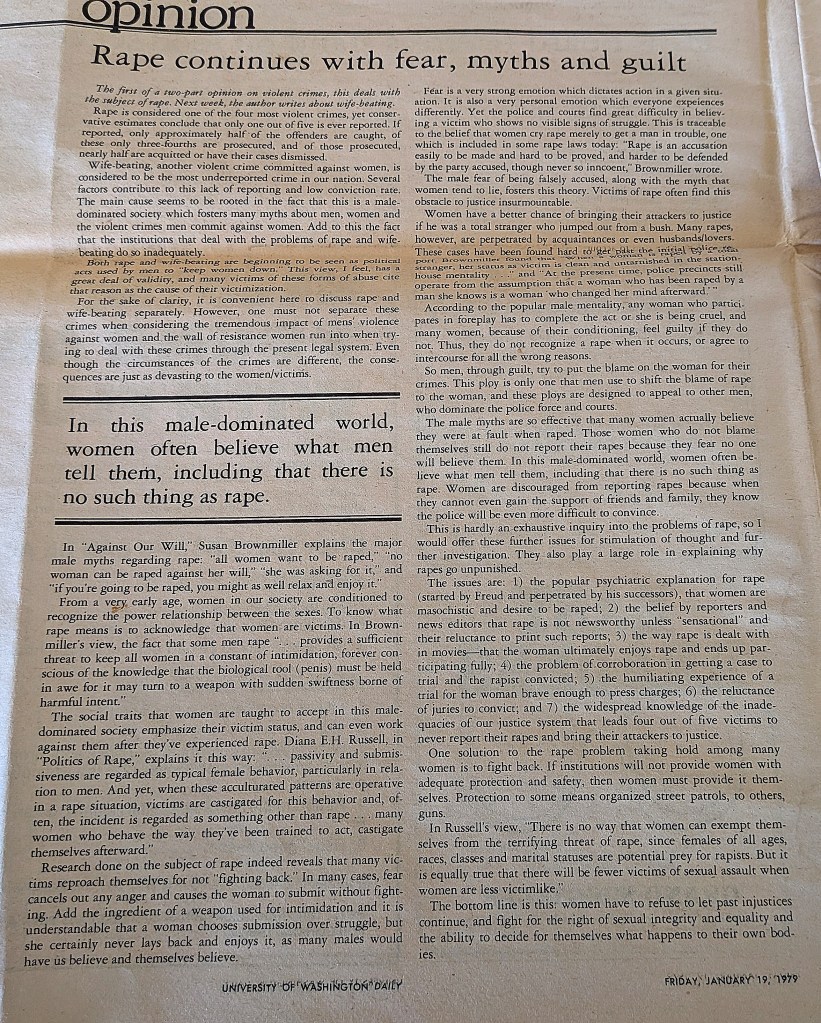
Rape continues with fear, myths and guilt
The Daily: The first of a two-part opinion on violent crimes, this deals with the subject of rape. Next week, the author writes about wife-beating.
Rape is considered one of the four most violent crimes, yet conservative estimates conclude that only one out of five is ever reported. If reported, only approximately half of the offenders are caught, of these only three-fourths are prosecuted, and of those prosecuted, nearly half are acquitted or have their cases dismissed.
Wife-beating, another violent crime committed against women, is considered to be the most underreported crime in our nation. Several factors contribute to this lack of reporting and low conviction rate. The main cause seems to be rooted in the fact that this is a male-dominated society which fosters many myths about men, women and the violent crimes men commit against women. Add to this the fact that the institutions that deal with the problems of rape and wife-beating do so inadequately.
Both rape and wife-beating are beginning to be seen as political acts used by men to “keep women down.” This view, I feel, has a great deal of validity, and many victims of these forms of abuse cite that reason as the cause of their victimization.
For the sake of clarity, it is convenient here to discuss rape and wife-beating separately. However, one must not separate these crimes when considering the tremendous impact of mens’ violence against women and the wall of resistance women run into when trying to deal with these crimes through the present legal system. Even though the circumstances of the crimes are different, the conquences are just as devasting to the women/victims.
In “Against Our Will,” Susan Brownmiller explains the major male myths regarding rape: “all women want to be raped,” “no woman can be raped against her will,” “she was asking for it,” and “if you’re going to be raped, you might as well relax and enjoy it.”
From a very early age, women in our society are conditioned to recognize the power relationship between the sexes. To know what rape means is to acknowledge that women are victims. In Brownmiller’s view, the fact that some men rape “… provides a sufficient threat to keep all women in a constant [state] of intimidation, forever conscious of the knowledge that the biological tool (penis) must be held in awe for it may turn to a weapon with sudden swiftness borne of harmful intent.”
The social traits that women are taught to accept in this male-dominated society emphasize their victim status, and can even work against them after they’ve experienced rape. Diana E.H. Russell, in “Politics of Rape,” explains it this way: passivity and submissiveness are regarded as typical female behavior, particularly in relation to men. And yet, when these acculturated patterns are operative in a rape situation, victims are castigated for this behavior and, often, the incident is regarded as something other than rape…; many women who behave the way they’ve been trained to act, castigate themselves afterward.”
Research done on the subject of rape indeed reveals that many victims reproach themselves for not “fighting back.” In many cases, fear cancels out any anger and causes the woman to submit without fighting. Add the ingredient of a weapon used for intimidation and it is understandable that a woman chooses submission over struggle, but she certainly never lays back and enjoys it, as many males would have us believe and themselves believe.
Fear is a very strong emotion which dictates action in a given situation. It is also a very personal emotion which everyone experiences differently. Yet the police and courts find great difficulty in believing a victim who shows no visible signs of struggle. This is traceable to the belief that women cry rape merely to get a man in trouble, one which is included in some rape laws today: “Rape is an accusation easily to be made and hard to be proved, and harder to be defended by the party accused, though never so innocent,” Brownmiller wrote.
The male fear of being falsely accused, along with the myth that women tend to lie, fosters this theory. Victims of rape often find this obstacle to justice insurmountable.
Women have a better chance of bringing their attackers to justice if he was a total stranger who jumped out from a bush. Many rapes, however, are perpetrated by acquaintances or even husbands/lovers. These cases have been found hard to get past the initial police report.
Brownmiller found that “When a woman is raped by a total stranger, her status as victim is clean and untarnished in the station-house mentality….” And, “At the present time, police precincts still operate from the assumption that a woman who has been raped by a man she knows is a woman ‘who changed her mind afterward.’ “
According to the popular male mentality, any woman who participates in foreplay has to complete the act or she is being cruel, and many women, because of their conditioning, feel guilty if they do not. Thus, they do not recognize a rape when it occurs, or agree to intercourse for all the wrong reasons.
So men, through guilt, try to put the blame on the woman for their crimes. This ploy is only one that men use to shift the blame of rape to the woman, and these ploys are designed to appeal to other men, who dominate the police force and courts.
The male myths are so effective that many women actually believe they were at fault when raped. Those women who do not blame themselves still do not report their rapes because they fear no one will believe them. In this male-dominated world, women often believe what men tell them, including that there is no such thing as rape. Women are discouraged from reporting rapes because when they cannot even gain the support of friends and family, they know the police will be even more difficult to convince.
This is hardly an exhaustive inquiry into the problems of rape, so I would offer these further issues for stimulation of thought and further investigation. They also play a large role in explaining why rapes go unpunished.
The issues are: 1) the popular psychiatric explanation for rape (started by Freud and perpetrated by his successors), that women are masochistic and desire to be raped; 2) the belief by reporters and news editors that rape is not newsworthy unless “sensational” and their reluctance to print such reports; 3) the way rape is dealt with in movies—that the woman ultimately enjoys rape and ends up participating fully; 4) the problem of corroboration in getting a case to trial and the rapist convicted; 5) the humiliating experience of a trial for the woman brave enough to press charges; 6) the reluctance of juries to convict; and 7) the widespread knowledge of the inadequacies of our justice system that leads four out of five victims to never report their rapes and bring their attackers to justice.
One solution to the rape problem taking hold among many women is to fight back. If institutions will not provide women with adequate protection and safety, then women must provide it themselves. Protection to some means organized street patrols, to others, guns.
In Russell’s view, “There is no way that women can exempt themselves from the terrifying threat of rape, since females of all ages, races, classes and marital statuses are potential prey for rapists. But it is equally true that there will be fewer victims of sexual assault when women are less victimlike.”
The bottom line is this: women have to refuse to let past injustices continue, and fight for the right of sexual integrity and equality and the ability to decide for themselves what happens to their own bodies.
FRIDAY, JANUARY 19, 1979
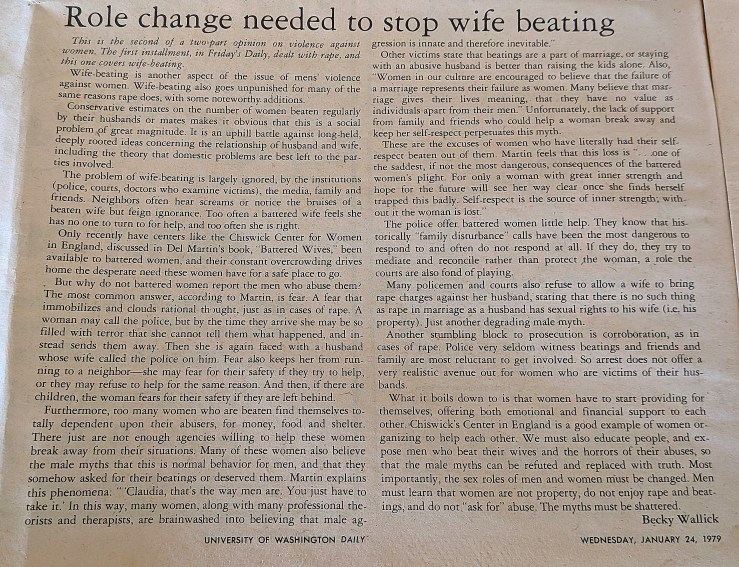
Role change needed to stop wife-beating
The Daily: This is the second of a two-part opinion on violence against women. The first installment, in Friday’s Daily, deals with rape, and this one covers wife-beating.
Wife-beating is another aspect of the issue of mens’ violence against women. Wife-beating also goes unpunished for many of the same reasons rape does, with some noteworthy additions.
Conservative estimates on the number of women beaten regularly by their husbands or mates makes it obvious that this is a social problem of great magnitude. It is an uphill battle against long-held, deeply rooted ideas concerning the relationship of husband and wife, including the theory that domestic problems are best left to the parties involved.
The problem of wife-beating is largely ignored, by the institutions (police, courts, doctors who examine victims), the media, family and friends. Neighbors often hear screams or notice the bruises of a beaten wife but feign ignorance. Too often a battered wife feels she has no one to turn to for help, and too often she is right.
Only recently have centers like the Chiswick Center for Women in England, discussed in Del Martin’s book, “Battered Wives,” been available to battered women, and their constant overcrowding drives home the desperate need these women have for a safe place to go.
But why do not battered women report the men who abuse them? The most common answer, according to Martin, is fear. A fear that immobilizes and clouds rational thought, just as in cases of rape. A woman may call the police, but by the time they arrive she may be so filled with terror that she cannot tell them what happened, and instead sends them away. Then she is again faced with a husband whose wife called the police on him. Fear also keeps her from running to a neighbor—she may fear for their safety if they try to help, or they may refuse to help for the same reason. And then, if there are children, the woman fears for their safety if they are left behind.
Furthermore, too many women who are beaten find themselves totally dependent upon their abusers, for money, food and shelter. There just are not enough agencies willing to help these women break away from their situations. Many of these women also believe the male myths that this is normal behavior for men, and that they somehow asked for their beatings or deserved them. Martin explains this phenomena: ” ‘Claudia, that’s the way men are. You just have to take it.’ In this way, many women, along with many professional theorists and therapists, are brainwashed into believing that male aggression is innate and therefore inevitable.”
Other victims state that beatings are a part of marriage, or staying with an abusive husband is better than raising the kids alone. Also, “Women in our culture are encouraged to believe that the failure of a marriage represents their failure as women. Many believe that marriage gives their lives meaning, that they have no value as individuals apart from their men.” Unfortunately, the lack of support from family and friends who could help a woman break away and keep her self-respect perpetuates this myth.
These are the excuses of women who have literally had their self-respect beaten out of them. Martin feels that this loss is “…one of the saddest, if not the most dangerous, consequences of the battered women’s plight. For only a woman with great inner strength and hope for the future will see her way clear once she finds herself trapped this badly. Self-respect is the source of inner strength; without it the woman is lost.”
The police offer battered women little help. They know that historically “family disturbance” calls have been the most dangerous to respond to and often do not respond at all. If they do, they try to mediate and reconcile rather than protect the woman, a role the courts are also fond of playing.
Many policemen and courts also refuse to allow a wife to bring rape charges against her husband, stating that there is no such thing as rape in marriage as a husband has sexual rights to his wife (i.e. his property). Just another degrading male myth.
Another stumbling block to prosecution is corroboration, as in cases of rape. Police very seldom witness beatings and friends and family are most reluctant to get involved. So arrest does not offer a very realistic avenue out for women who are victims of their husbands.
What it boils down to is that women have to start providing for themselves, offering both emotional and financial support to each other. Chiswick’s Center in England is a good example of women organizing to help each other. We must also educate people, and expose men who beat their wives and the horrors of their abuses, so that the male myths can be refuted and replaced with truth. Most importantly, the sex roles of men and women must be changed. Men must learn that women are not property, do not enjoy rape and beatings, and do not “ask for” abuse. The myths must be shattered.
Becky Wallick
WEDNESDAY, JANUARY 24, 1979
***
Here are photos of the yellowed-with-time pages of those old University of Washington Daily issues that published my paper in two parts.
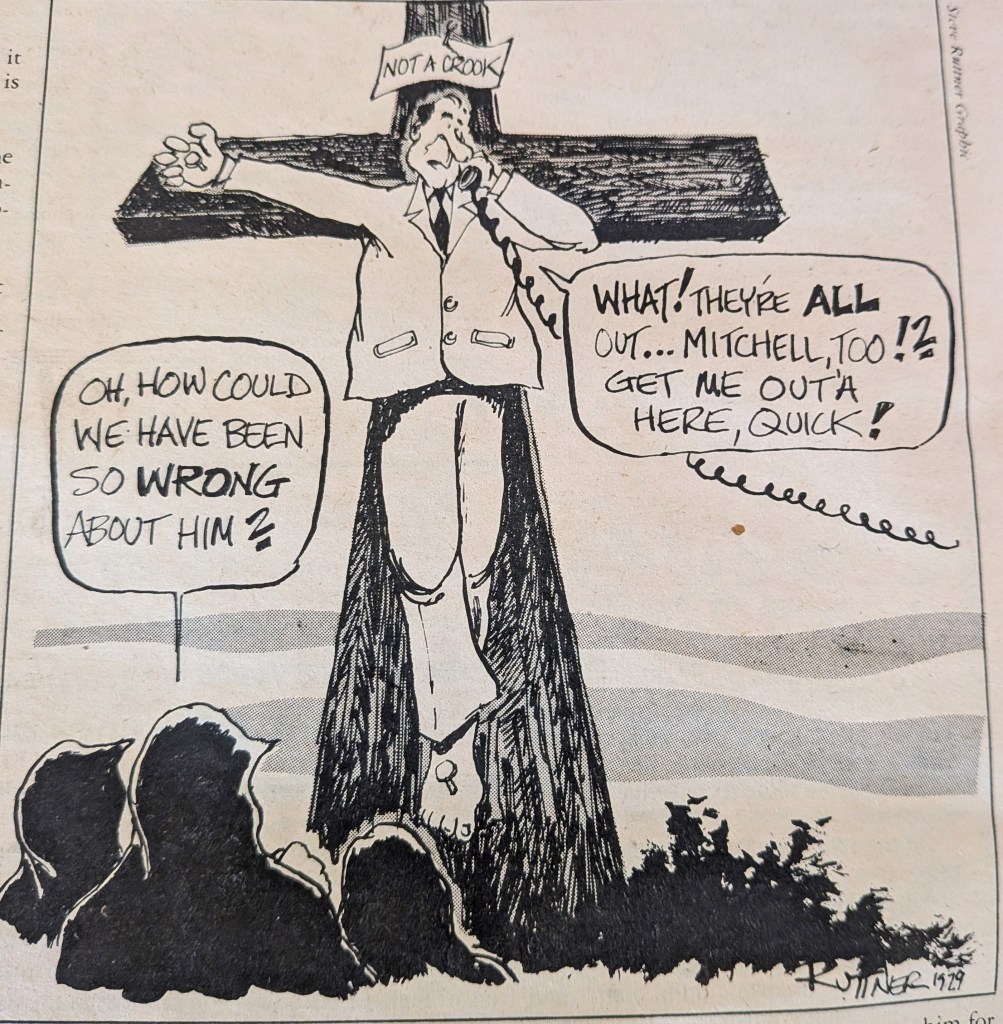
On the same page of the Daily as the second part of my paper, I found this political cartoon, yet another example of, The more things change, the more they stay the same.