

Meaning: giving advice or suggestions without being asked.
This post is based on my individual experiences and, ironically, provides some (unsolicited) social manners advice based on those experiences at the end.
My Most Recent Encounter with Unsolicited Advice
(Feel free to skip to the next section. What follows here is my peculiar and extended pain journey, serving mostly as a way for me to “put a pin in it” for future reference. It’s only tangentially relevant to the topic of unsolicited advice, but it does illustrate how unique my situation has been and why I felt unsolicited advice from others was way off base.)
What got me so agitated that I felt the need to write this long-winded blog post?
Let me bring you up to speed on the crazy health journey I’ve been on. It also explains why I’ve been an irregular and mostly absent blog correspondent. Turns out for me, chronic severe pain is not conducive to writing.
Since the spring of 2022, I’ve endured debilitating nerve pain in my left leg. Sometimes in the hip area, but usually in the shin. Because of COVID, I couldn’t see a PCP until March 2023, a year after onset. I used that delay productively, researching, and realized I had a repetitive motion injury to my sacroiliac (SI) joint. It’s a large, nearly immobile joint connecting the hip joint to the spine. However, if an injury affects the ligaments supporting it, the joint can move. After hauling firewood from my basement to the living room for five months over winter 2021-2022, with the heavy weight always on my right side, then kneeling awkwardly in front of an old wood-burning stove that was my only source of heat to stoke it day and night, it wasn’t surprising I’d damaged the SI joint.
Referred to various pain clinics in Vermont and New Hampshire, I underwent various diagnostic imaging and tried various treatments. The only thing that helped were corticosteroid injections to my sacroiliac (SI) joint. I had 95 percent relief after each injection, but the benefit wore off after four weeks and by eight weeks I was back to square one. I had one SI joint injection while in Vermont, as well as injections to my left hip and bursa, neither of which provided any relief. Imaging didn’t show any issues with my hip or my SI joint.
While in Vermont, I kept re-injuring my SI joint. For example, dragging a pissed-off 80-pound Chann off a skunk, and three months later, off a porcupine. I liken those repeated injuries to spraining your ankle, then re-spraining it several times over the space of a few months because it never truly healed. The result is an ankle with ligaments and tendons that are lax from repeated injury, making it easier to re-injure. After at least four separate SI joint injuries over a year or two, mine was so lax that simply bending over to pull weeds caused re-injury.
In the months after moving back to Idaho in late 2024 I had two more successful injections into my left SI joint.
Those injections were also diagnostic: they demonstrated that my left SI joint was the source of my nerve pain, even though many doctors assumed it was my hip and/or spine as they are the more typical causes of “referred” nerve pain down a leg.
The only long-term fix: SI joint fusion surgery. A surgeon puts two or three screws across the SI joint space (from sacrum to ilium), permanently fixing it in place.
After several false starts, in March of this year I found a surgeon who did the procedure using the hardware I preferred. But before insurance covered the surgery, I had to jump through a few more diagnostic hoops.
One was getting x-rays of my pelvis and hips. That happened in May.
The results were shocking. When I saw the images in MyChart, I almost threw up. My right hip was normal, but my left hip joint was… gone. No cartilage left. Bone-on-bone. Stage 4 (end stage) osteoarthritis.
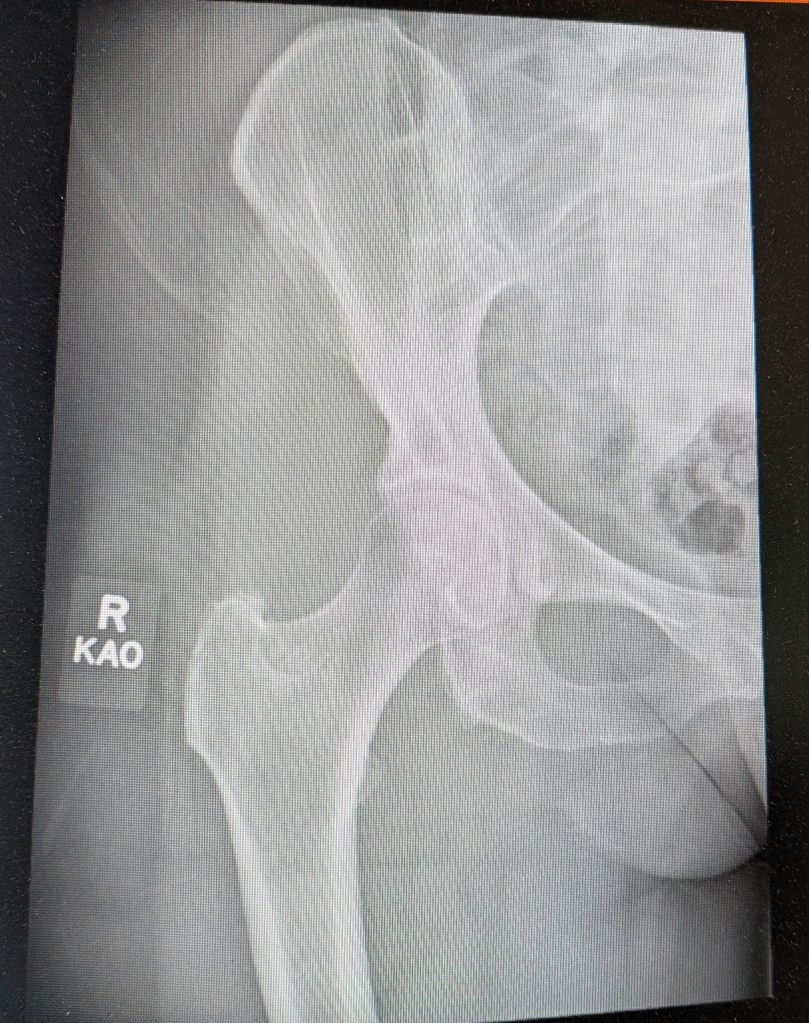
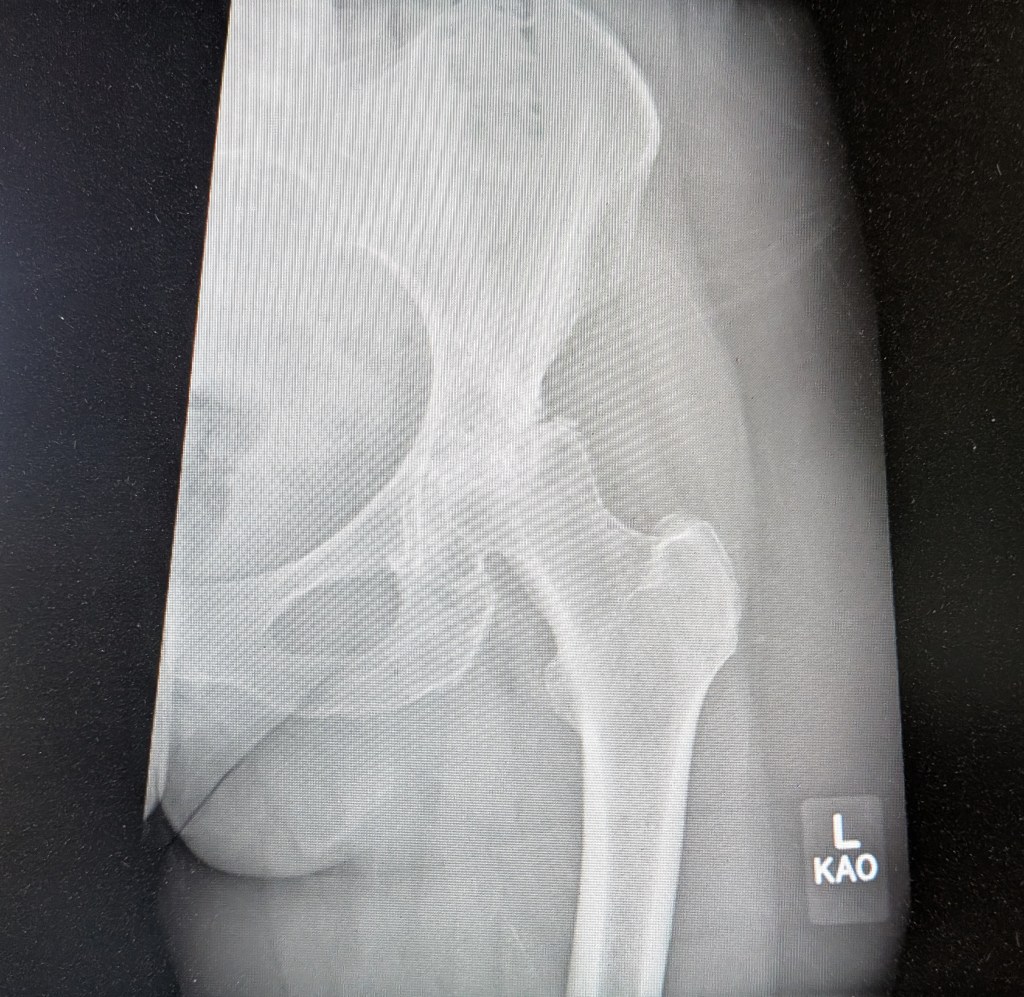
Yet I hadn’t felt a thing. Or, more specifically, the only pain I felt was my old friend, SI joint pain, which was a deep ache in the butt along with that sharp nerve pain in my shin.
How was it possible that I didn’t know my hip was deteriorating?
The local radiologist reading the images offered a clue in his report. He had compared the May 2026 x-rays with previous images in my records from October 29, 2024, December 6, 2023, and July 26, 2023. He noted how quickly the degeneration occurred. Then he made a diagnosis:
“Left hip: Severe degenerative changes with bone-on-bone joint space narrowing, subchondral collapse, and remodeling of the femoral head. Marginal osteophyte formation is observed. Findings are concerning for Charcot joint pathology.”
I went from a normal hip in late October 2024 to a destroyed hip by May 2026, just 18 months. Unheard of, absent something rare.
When I used Copilot (AI) to research Charcot joint pathology, also known as Charcot’s arthropathy, I initially dismissed the finding because it’s most common in diabetics who lose nerve sensation to their ankles and feet. They can’t feel the joint degeneration. I’m not diabetic. But in a deeper dive, I learned it can happen in other joints, like the hip or shoulder, particularly in a subset of people with neural tube defects that can cause a loss of sensation in certain areas of the body.
The puzzle pieces were falling into place.
I was born with spina bifida occulta (SBO), defined as a mild and the most common type of spina bifida. Spina bifida is a condition present at birth (a congenital birth defect) caused by your spine forming incorrectly during fetal development.
The word “occulta” means “hidden.”
About 1 in 10 adults have SBO, and most never have symptoms. Many people don’t know they have it until an X‑ray or MRI shows that one or more vertebrae look different or there’s a defect in the neural tube.
Some of us also have signs of a serious issue like a tethered spinal cord, which means the spinal cord is being stretched.
My tethered spinal cord was discovered via a low-spine MRI after I began experiencing orthostatic (positional) headaches around 2003, the result of a hard fall while trail running. That MRI also disclosed mild scoliosis and partially fused L3-L4 vertebrae. That was the start of my CSF (cerebrospinal fluid) leaking journey. I continue to leak, but I’ve learned how to live with my symptoms.
Looking at the loss of my left hip joint through this larger lens of my birth defects, it made sense to me that the nerve(s) that feed my left hip are likely compromised. They leave the lumbar spine at the level of my defects. That explains why I didn’t feel pain in my hip joint. That’s how I got all the way to stage 4 (end-stage) osteoarthritis in my left hip without pain.
I went back to Copilot to research next steps. The clear, evidence-based conclusion: fix the hip first, worry about the SI joint later. Especially since one research paper concluded that 50-90 percent of patients with both hip and SI joint issues found their SI joint pain resolved after their hip was repaired.
Plus, if my SI joint issues weren’t resolved after hip replacement, I could still get SI joint fusion surgery later.
I saw a local orthopedic surgeon at the end of May. He questioned the Charcot’s arthropathy diagnosis, primarily because he’d never seen it in a hip joint, but admitted I had no option but to undergo total hip replacement.
Unfortunately, I had to wait three months to get on his schedule.
Those three months of waiting were hell. Week by week, I gradually lost mobility. My SI joint was still screaming at me, making it hard to sleep or sit anywhere but on a yoga ball, but I couldn’t have another corticosteroid injection within three months of surgery.
I stopped taking my dogs for walks, which broke my heart. I relied on others—to clean my house, mow my yard, walk my dogs, lift and move heavy objects. I could barely do my grocery shopping and had to use a wagon to bring items from my car inside to my pantry and fridge.
I shared my hip x-rays and Charcot’s arthropathy diagnosis on my personal Facebook page to keep friends up to speed. They already knew about the SI joint issue and that I was nearing surgery for that, so needing a total hip replacement was a 180-degree change in plan.
That’s when I discovered just how many people I knew had undergone their own hip replacements. A few eventually had both hips replaced. Most of them assured me my hip pain would be gone immediately after surgery and that recovery was relatively quick and easy.
Those comments were both reassuring and helpful. I’m a big believer in anecdotal evidence.
But there were many other comments on my Facebook post that were unhelpful and downright annoying.
Advice given that I never sought.
Annoying Advice
I spent over 30 years working as a family law attorney. Countless times, friends, family, and strangers at social gatherings would ask for advice. My knee-jerk response was always, “Sure, but it’ll be worth what you pay for it.”
In other words, nothing.
Early in my legal career, I realized that unless someone paid for my advice, they’d ignore it. If it cost them nothing, they assigned it a low value. Family members were the worst offenders.
The lesson I took from those experiences is to never offer advice, legal or other. Instead, wait until someone sincerely asks for advice (i.e., not at a party after they’ve had a few drinks), and even then, be sure you have relevant and valuable advice to offer. For example, “I once went through a similar situation. Here’s what I found helpful.” Otherwise, shut up.
That’s a lesson more people need to read/hear and incorporate into their personal and online lives.
Offering one’s lived experience—anecdotal evidence—can be valuable. I learned so much from a neighbor who had her hip replaced by my surgeon in May. She was three months ahead of me in terms of recovery. Our paths through recovery have been slightly different, but that’s no surprise. For example, she had her right hip replaced, so she couldn’t drive for a couple of months; she didn’t feel confident in her ability to stomp on the brake if necessary. Still, just sharing our post-surgery journeys with each other was affirming and supportive.
My neighbor didn’t offer unsolicited advice. Instead, she shared her own experience. Vastly different things.
Unfortunately, my Facebook friends’ pre- and post-surgery unsolicited advice was often erroneous, out of date, or just plain bad. A few examples:
You’ll have to board your dogs for several weeks to avoid accidents at home and, because you can’t bend at the waist, you won’t be able to feed them or refill their water bowls.
Because you live alone, you’ll require 24/7 in-home care for at least two weeks, maybe a month.
You must take up all area rugs; they’re a tripping hazard.
You won’t be able to drive for at least a month, maybe three.
You’ll be on the couch for the first week, crutches for a couple of weeks after that, then a cane for a month.
Um, no.
In contrast to those voices, my surgeon was quite blasé about preparing for my recovery. He knew that by using an anterior incision and a dual-mobility implant (which I specifically advocated for because of my lax SI joint and scoliosis), the chances of my new joint dislocating because of bending or moving my surgical leg were virtually nil, even right after surgery. He wanted me up and walking immediately, a few minutes every hour when I wasn’t icing the incision and elevating my feet because of swelling at the surgical site. There was just a single movement restriction: don’t swing my surgical leg way back while simultaneously turning it outward until everything has healed. That was it. Every other movement was fine, “as tolerated.”
Once home, my surgeon only asked that I have a “coach,” someone living nearby who I could call in an emergency. Since my primary living space doesn’t have stairs, and I have a walk-in shower, I got around easily the first few days using a walker. I didn’t need someone to stay with me.
And I most certainly didn’t board my dogs, who are calm and well-behaved and would never topple me. I wanted them home with me, a source of comfort. Nor did I take up the area rugs, which are there for Conall, who will soon be 12 and has his own mobility issues (bad knees). The rugs have non-slip backing and are about a tenth of an inch thick, so not a trip hazard.
As each day of recovery passed, I recognized how poor most of the unsolicited advice I’d received truly was. But, as a polite person, I didn’t argue with them publicly on Facebook, or even privately via Messenger. I didn’t have energy to waste.
My Actual Hip Replacement Experience
My total hip replacement surgery happened on September 1st. I was never so excited to go under the knife.
My surgeon suggested I spend the night after surgery in the hospital so I could rest, eat, and start walking with a nurse’s assistance, which I did every couple of hours through that first night. To each nurse I said, “I can’t believe I’m walking normally! Without pain!” I was so happy.
I used a walker for a week. At my first PT appointment one week after surgery, I was told I could drive because I wasn’t taking any narcotic pain medicine and I didn’t need my left (surgical) leg to hit the brake. I switched to using a single trekking pole at that point, something I’d done for three months prior to surgery because of pain.
At two weeks post-surgery, I began walking around the house without the trekking pole. My physical therapist gave me the green light to resume riding my recumbent stationary bike with light resistance and to increase my walking distance. By three weeks, I was walking stairs normally, and I could walk to my mailbox (a third of a mile round trip), around the grocery store, and to appointments without a trekking pole. I tire easily, but that’s something I expected.
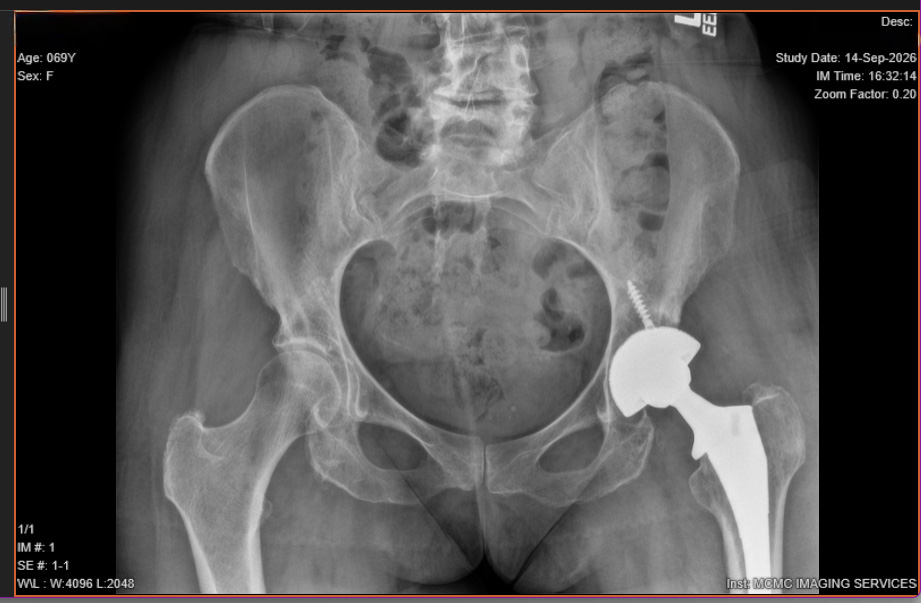
As I write this, I’m one-month post-surgery and working to regain the muscle strength, balance, and endurance I lost over the several months leading up to surgery. My short-term goal: to be ready to cross-country ski again in January.
Best of all: I no longer have that awful nerve pain in my shin! The hip replacement has, so far at least, cured my SI joint pain. Yay! For the first time in four years, I can sleep on my side or back. I can walk and sit on a regular chair without nerve pain starting. The real test—whether I can run without nerve pain—will have to wait until I get clearance from my surgeon and PT to start light jogging. My surgeon told me that when I’m fully healed (roughly three months, but possibly up to six), I can resume trail running. “Just don’t run an ultramarathon,” he joked.
The difference between my experience and that of friends who offered their unsolicited advice reminds me of a saying coined by a fellow ultra runner in the early 1990s: We’re all an experiment of one. My corollary: What works for you may or may not work for me; let me decide for myself.
Why Does Unsolicited Advice Hit So Badly?
Still, my annoyance at the unsolicited advice from my Facebook friends persisted, like a fly buzzing around my head that I couldn’t swat away. But why? Even knowing they had good intentions, their advice left me feeling… insulted.
My gut reaction to each bit of advice was, Wow. They clearly think I’m stupid. That I can’t ask my surgeon questions and follow his instructions. That I’m incapable of doing my own research. That I’m helpless without their guidance. They must think I’m incompetent.
I nearly unfriended a couple of those Facebook friends. I “paused” one of them. Most of them are people I haven’t seen in person since moving away from Seattle in 2005. Some I’ve never met in real life, instead connecting through blogging or writing. No matter, despite never seeing my current home, my dogs, or my ability to live independently, they each felt confident I needed their advice on what I should do to recover from my surgery.
Curious if others shared my strong negative reaction to unsolicited advice, I did some research. Turns out it’s a thing. Negative reactions are common. This is what I learned:
Giving uninvited advice carries an underlying assumption that the receiver’s current approach is wrong. The advice implies that one cannot solve a problem on one’s own, or that the giver knows their situation better than they do.
Psychologically, unsolicited advice can trigger a defensive threat response in the brain, making it feel like an attack rather than help. While some advice givers act out of genuine care, most uninvited advice stems from the giver’s ego, need for control, or sense of superiority: “I’m wiser and more experienced than you, so let me tell you what you should do.”
Did I mention how much I hate the word should that people often use in unsolicited advice?
No wonder I, and most people, receive unsolicited advice as presumptive, arrogant, and boundary-crossing, loaded with assumptions: that the other person even wants your advice; that the person can’t figure it out without your advice; that your advice is right for that person; that the person hasn’t already thought of what you’re sharing.
So, please, just… stop giving unsolicited advice.
Because really, the underlying message whenever you do is, I know what’s right for you more than you do, which is criticism. Your friends didn’t ask for your criticism.
A few quotes to drive the message home.
I never give advice unless someone asks me for it. One thing I’ve learned, and possibly the only advice I have to give, is to not be that person giving out unsolicited advice based on your own personal experience. —Taylor Swift
Unsolicited advice is always self-serving. —Amy Dickinson
Unsolicited advice is the junk mail of life. —Bernard Williams
And, a tongue-in-cheek quote: I always pass on good advice. It is the only thing to do with it. It is never of any use to oneself. —Oscar Wilde
Dolly Parton said it best. I don’t like to give advice. I like to give people information because everyone’s life is different, and everyone’s journey is different.
Be like Dolly (may she rest in peace). If you can’t resist, and you value the friendship, simply offer useful, relevant personal anecdotes rather than advice laden with you should….
And that, dear readers, concludes my rant-filled take on the dangers of unsolicited advice on social (and social media) manners😉
Feature image: My dogs at sunrise on September 12, 2026. Conall and Chann never offer me unsolicited advice. Instead, they provide me with gobs of unconditional love for which I’m eternally grateful.


I was just thinking about you this morning and planning to check your blog to see if I’d missed anything. I’m so glad you’ve gotten relief from that horrible pain! And I like the quote from Dolly Parton; she was such a wise and loving person. Best wishes for continued healing and rebuilding your strength!
LikeLiked by 1 person
Kim! Thanks for reading, and yes, to be rid of chronic pain and the brain fog that accompanies it is such a relief. And now, I’ve finally caught up with your blog; glad to see you’ve returned to more regular posting with your usual amazing photos.
LikeLiked by 1 person
What a dreadful journey to an ultimately happy ending. As to unsolicited and and bad advice, well, you did use the word “Facebook” in the same sentence. But a classic case of all’s well that ends well and it sounds like you (with ample support from the furballs) have made a spectacular recovery and I fully expect to see some X-country ski photos of Mals in the snow come January.
LikeLiked by 1 person
Yeah, yeah, I know; my bad for over-sharing on Facebook. Apparently my hopes and expectations were a tad high for social media 🙂 Lesson learned! As for x-c skiing photos with Mals, that will have to wait (most likely) until January, but I promise to deliver, probably ad nauseam (careful what you ask for)!
LikeLike