Since moving to Idaho in 2005, living a slower-paced lifestyle than what I left behind in Seattle, I’ve become fascinated with birds. I’m astounded how much I’ve learned about them over the years, and how much joy they bring me, especially when life is challenging.
At my first house in Meadows Valley (2005-2021), I developed relationships with House Wrens, Tree Swallows, and Ravens. My dogs were included in the relationships.
With the House Wrens, Conall found a fledgling inside the dog yard, in the grass, not far from the hole in the siding of the garage that was their nest. He picked it up in his mouth. I saw it happen, told him to “Drop it!” and thankfully he did. I escorted the startled baby bird to a safe perch on the other side of the fence, closer to the nest. One of its parents watched, chirping excitedly. Because Conall’s drool left the tiny fledgling with a damp head and a couple of feathers standing straight up in a Mohawk style, I was able to recognize it over the next couple of days. I watched, almost with parental price, as it practiced its flying skills with its siblings, flying over the roof of my house and landing on the fence railing on the other side under the watchful eyes of its parents.
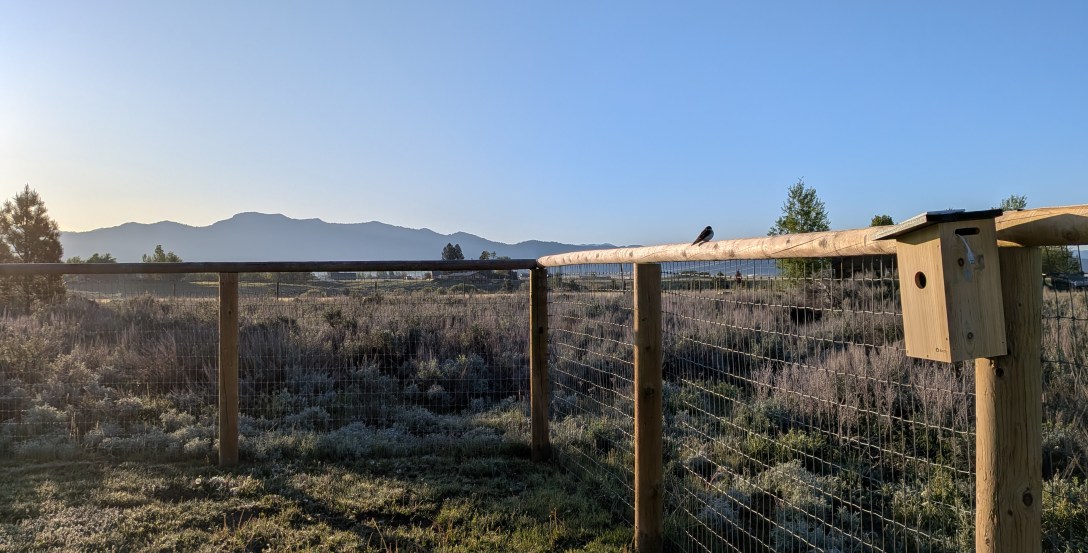
A pair of Tree Swallows adopted a lone nest box nailed to the yard fence rail. Conall, Finn, and I would sit on the grass nearby on warm summer evenings, enjoying the sun’s slow descent toward the mountains to the west, watching the swallows fly aerobatics overhead, feeding on bugs. They’re amazing flyers, described by one pilot friend as the fighter pilots of the bird world. The swallows often strafed us, more for fun on their part than any sense that we were a danger.
One day I noticed Conall slowly approaching the nest box. He was young and curious about everything. Eventually he sat just below the box, his ears perked and head tilting to one side, then the other, listening intently. That’s when I knew there must be babies inside, telling their parents they were hungry.
The Ravens were the most fun. The winter of 2020-2021 I began to notice a pair that flew low over my house and yard every morning, returning in the opposite direction in the evening. I realized they roosted in the tall pines of the national forest just a half-mile away. By this time, Conall was six years old and a proficient vole hunter, even when there was two-to-three feet of snow covering the yard. He didn’t eat the voles, and I felt bad, for the voles and that a source of food for other animals went to waste. That winter, with deep snow covering the yard and adjacent field, I began pitching the dead voles over the fence into the field. From my office winter, I observed one or both of the Ravens investigating and eventually flying off with the voles. I took photos and video, thoroughly enjoying what I was seeing. The Ravens, Conall, and I were developing true relationship.
I wondered if I could entice the Ravens to come closer to my office window so I could get better photos and video. Instead of pitching the voles into the field, I began leaving them atop the snow inside the fence, in places where I’d have a good view from my office, about ten feet from the house. At first, the vole offerings disappeared only when the boys and I drove away from the house; I was certain the Ravens watched for that sign it was safe. Later, when Conall and Finn were inside, the Ravens were brave enough to swoop low over the yard, then quickly pick up and fly off with the vole offerings. Unfortunately, the boys learned that if I suddenly grabbed my phone and leaned over my desk to look out the window, it meant the Ravens were nearby; they’d go crashing out through the dog door, startling the Ravens away. (Finn didn’t like the Ravens and would bark at them whenever they flew low over our house, or if they flew near us on trail runs. Apparently Australian shepherds are too far removed from their wolf ancestors to know that Ravens and wolves cooperate in the wild and shouldn’t be considered the enemy.)
Here are links to a series of three blog posts I published in late 2020 through early 2021: Symbiosis: Ravens and Dogs; Conall’s Food Bank for Ravens; and Building Trust with Ravens.
It broke my heart to leave those Ravens behind when the boys and I moved to Vermont in July 2021, so soon after our relationship began. I did learn about Black-capped Chickadees while in Vermont, though, and I’m happy to see them visit my feeders and eat bugs off the side of my house in McCall.
***
Now that I have a similar yard fence as at my Meadows Valley house, with round top rails at my house in McCall, I’m putting up nest boxes, hoping to create new up-close experiences with songbirds. (There aren’t as many Ravens where I live now, and Conall is no long the Mighty Vole Hunter. Chann tries but mostly fails.) I put up two boxes last autumn, past nesting season, and was thrilled when I saw Mountain Bluebirds checking one out because I’d read that birds often choose boxes they’ve checked out the year before (or previously built nests in). First year boxes can go unused.
Over the winter, I started putting up bird feeders. They attracted Mountain and Black-capped Chickadees as well as Goldfinches. Unfortunately, they also attracted Magpies and, early this spring, like, mid-February, male Red-winged Blackbirds. I bought a tray-style feeder that had a camera, and while the smaller birds visited, the larger birds crowded them out.
I made changes: I stopped using the tray feeder with camera; I put just nyjer (thistle seed) in one tube feeder, for the Goldfinches; and I bought a new feeder with a wide-gauge wire cage around it for the Chickadees and Goldfinches, who can easily get through the wire to the actual feeder but the larger birds find it either impossible or too much trouble. (Hey, in for a penny, in for a pound on bird feeders and boxes…!)
Over time, word spread among the Goldfinches and I sometimes had as many as 30 at the feeder at a time.
As I waited to see if the two existing nest boxes would be claimed this spring, and by which species, I bought a new nest box with an interior motion-detecting camera and solar panel on top to keep the camera charged. Unfortunately, the camera was defective (wouldn’t connect to WiFi), so the company sent me a complete replacement. The second camera works perfectly. I put both the first box, sans camera, and the functioning camera box on the south fence rail, with one of last year’s boxes between them, earlier this spring. There are several yards between them all, and the other plain nest box from last year is on the west side rail, for four boxes total. I wasn’t really expecting either of the new boxes to be claimed, but was hopeful.
First to arrive were Tree Swallows. Lots of them, too many for just four nest boxes, so I wondered how this was going to play out. Eventually some began investigating the boxes, quickly going inside and just as quickly emerging. A bit like we humans viewing lots of houses before choosing one to rent or buy. This looking-but-not-buying behavior seemed to go on forever.
Now, it so happens that Chann like to poop close to the fence, along the perimeter of the yard. That makes for easy clean-up on my part (pitching “dog bombs” over the fence into my field), but it also means that every day I’m walking right by all of the nest boxes.
When the Tree Swallows became serious about choosing a box they would perch on the fence rail near that box, watching me closely as I approached. I slowed, and often stopped a few feet away, talking to them in my lame version of bird talk (basically clicking my tongue), trying to assure them I’m harmless. I took lots of photos and videos.
My calmness seems to have worked; they let me get quite close before flying away, usually landing a few feet down the rail, letting me walk past their nest box, then returning to it after I’ve passed. They’re a bit more hesitant when Chann or Conall come close, and they often swoop between or around us, just as I remember the Tree Swallow pair at my Meadows Valley house doing. Now, though, there are two pairs, at opposite ends of the yard.
By mid-May, two boxes were occupied: an old one from last year, and the newer one without a functioning camera.
In late April Tree Swallows started investigating the box with a functioning camera. I’d get alerts on my phone when this happened. Lots of video of a swallow head poking inside box, looking around, even right at the camera, then flying off. After several days of that, I started getting video of a swallow dropping inside the box, checking out the metal platform at the bottom, eyeing the camera again, then departing. Then two would be in the box together, briefly.
Eventually the swallows brought in a few bits of grass, so I celebrated, eager to watch the nest develop, eggs appear, and babies emerge.
Then, in an odd twist, on May 11th the camera box captured video of a House Wren checking out the interior of the box, but it hasn’t returned.
The Tree Swallows kept appearing on video in the box through mid-May, but for some reason they abandoned it. After no new videos for several days, I opened the box to check. Those bits of early nest-building materials were gone. It was then that I noticed a pair of Tree Swallows taking nest materials into one of last year’s boxes not far from the camera box; I’m guessing they started in the camera box, changed their minds, and took materials from the camera box to the older box they ultimately chose. Maybe they’re camera shy.
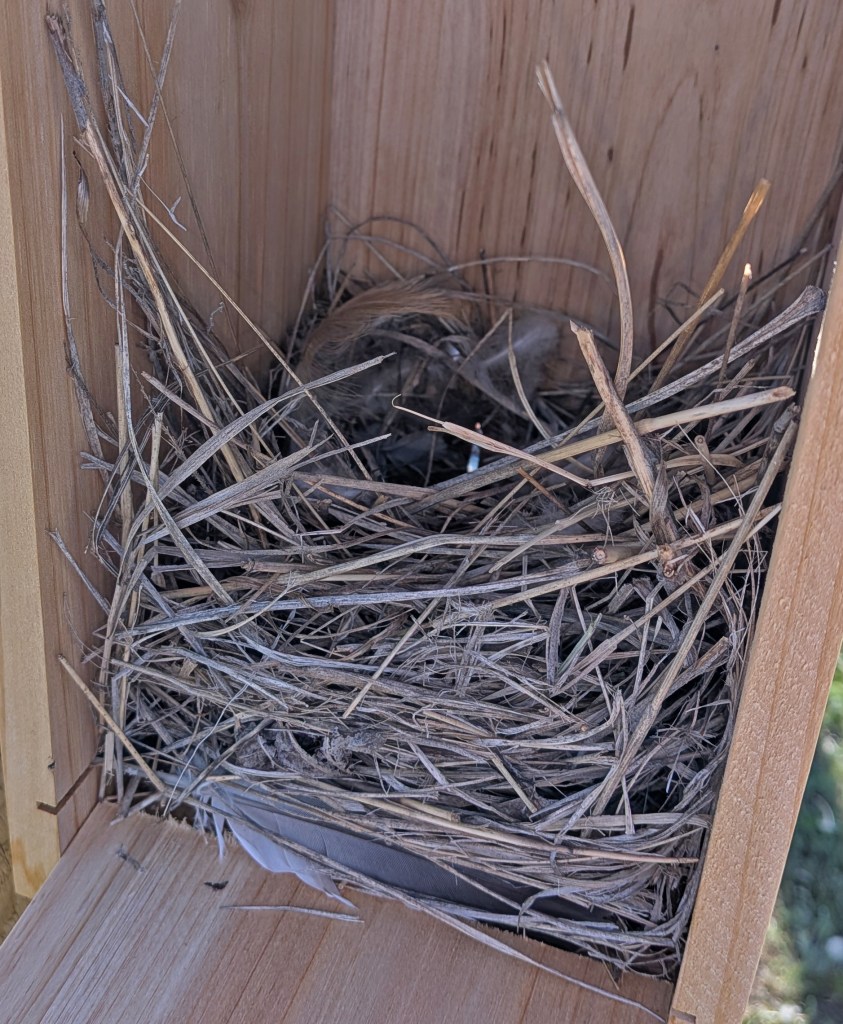
After being reassured that birds have poor senses of smell and won’t be upset if you touch their nest box, one morning I opened the back door of the new-but-no-camera box, and was amazed to see the progress that pair of swallows had made on their nest. I’d read they often incorporate the feathers of other birds into their nest, and I saw several.
I had also read that in my area, Tree Swallows are usually the first birds to return in spring to seek nest sites. They often claim nest boxes before the Mountain Bluebirds have returned, out competing them. I love Tree Swallows, but I wanted to host at least one pair of Mountain Bluebirds this summer.
Mountain Bluebirds are the Idaho state bird, and there was a time mid-20th century when their numbers were threatened because of lack of suitable nesting sites, the double whammy of habitat loss (they nest in tree cavities of dead trees, which were being cut and removed) and pesticide use. Compounding the problem, non-native species like European Starlings and House Sparrows aggressively invaded and took over the limited natural cavities. According to the Audubon Society, the Mountain Bluebird population was ultimately saved by massive grassroots conservation efforts. Dedicated local volunteers—most notably the renowned “Bluebird Man,” Alfred Larson—built, deployed, and monitored thousands of artificial nesting boxes across southern Idaho. Widespread installation of nest boxes, combined with improved land management practices, successfully stabilized the Mountain Bluebird population.
I waited with bated breath to see if a pair of Mountain Bluebirds would move into at least one the two remaining nest boxes on my fence rail.
And they did, into the camera box! Just this week; my first video of them is dated June 2nd. They may get a late start on building, but they’re determined and move fast once they start. I’m getting constant alerts of activity, the female bringing in small bits of grass and twigs, moving them around, using her feet to push and mold the material into the form of a cup with her wings spread and beak down for balance.
It’s fascinating to watch, worth every penny for the expensive box and camera (Birdfy brand, good customer support; roughly $100 at Chewy’s).
Meanwhile, having had a head start, the Tree Swallows have moved on to their next stage of ensuring another generation, which occurs outside the nest box: sex on the rails.
Because of all these birds in my yard, at the feeders and nest boxes, I’m less sad about not being physically able to get out into the forest as much as I want. (I’m still struggling with getting surgery to fuse my SI joint.) They’re fascinating to watch and learn about, a healthy distraction from things I can’t control or change.
It has become my early morning routine to walk the perimeter of the yard just after sunrise, both to clear “dog bombs” and to interact with my new bird friends, taking to them, taking photos and videos. The boys often follow me. The rest of the world is so quiet and peaceful at that time. I can all kinds of bird song, including the crowing of a neighbor’s rooster. It’s calming and uplifting to be present to see and hear it all.
The Mountain Bluebirds are a bit more wary of me and the boys, but they’re new the neighborhood so I hope they’ll learn to relax. I’m just glad they chose the camera box so I’ll get to see all stages of bringing a new generation of Mountain Bluebirds into being.
There’s one nest box that remains vacant, awaiting occupants. Maybe the House Wren will come back…?
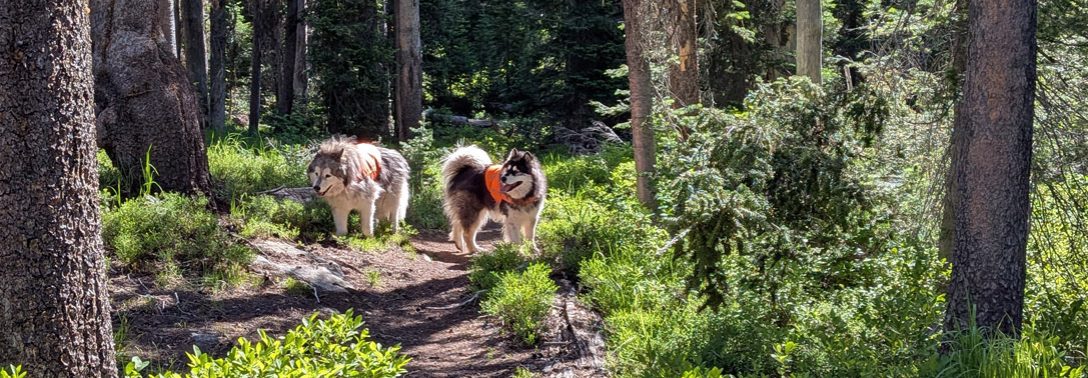
Featured image: walking the yard perimeter to check on the birds June 1, 2026.


I envy you the variety and number of bird friends. Here in the suburban plains of the Great LA Metropolitan Region we are bird starved save for the ubiquitous crows who seem to disdainfully laugh at our avian destitution. But there’s one species that has become a constant visitor at Chez Reiko and that’s the hummingbirds. Bunches and bunches and several have become year ’round residents foregoing the usual migration patterns to Mexico. I love these little guys and gals and they brighten every morning with their incessant bird wars defending and attacking the three feeders I keep well provisioned.
LikeLiked by 1 person
So that’s where all the hummers have gone: your place in LA! I see them only occasionally at my feeder, so yes, I’m grateful for all the other birds who make this area home and visit my feeders. One wonders, though, what you put in your feeder to convince the hummers to forego their usual migration and stay close all year… 😉
LikeLiked by 1 person
You mean besides the beer?
LikeLike
My experience here with migrating mountain bluebirds is that they are curious and calm people will make them relax. I bet you get closer soon. Ravens — I love them. There is a mated pair out at the Refuge I’ve been watching for years. They know me and when they see Bella they fly low to say hello to me. I greet them too. “Hi Rave!” often I get a caw in return. That’s a thing I learned in CA — familiarity with a human that doesn’t try anything seems to make wild animals something like “happy” — “Oh this one’s not after anything. OK.” A group of ravens one day wanted to show me their aerobatics in the wind. It’s great; it’s the essence of being a legit naturalist, really. And THOSE moments are the best things in my life and have been for a long long time. I love your nesting boxes. Wonderful things especially for you now.
LikeLiked by 2 people
Ravens are so smart. I learned they love to tease. Several years ago I frequently ran a local mtn bike trail system, at least once a week. Finn, my Aussie, and young Conall would join me. On one trail, a raven would often follow us, landing on a low tree branch to watch us run below him, then fly past us to the next tree branch to watch, etc. I started noticing that it would purposely swoop lowest over Finn, who would bark and try to herd it away. The raven seemed to enjoy getting that reaction. Someday I hope to entice a raven pair to hang out around my current property, but they seem to prefer pine trees to aspens, so we’ll see. In the meantime, I’m loving my interactions with the Mountain Bluebirds and Tree Swallows.
LikeLiked by 1 person
I loved watching the nestbox footage of the tree swallows. I think that pair might have mated while they were together in there, did you see that?
I would love to get a nest box with camera for my yard. My urban lot won’t attract bluebirds or tree swallows, but I do get a couple species of wrens that might use a box.
I spent the entire month of May obsessed with documenting the robins in my chokecherry tree. When the babies fledged and moved out of my yard, I didn’t know what to do with myself for a few days. I need to do another post updating their story. Like you, I derive lots of joy from watching the wildlife living in my yard!
LikeLiked by 1 person
I had no idea, when buying the camera nest box, it would provide so much (voyeuristic) entertainment! Now I’m watching a beautiful new blue egg appear each morning, curious how many the female will lay. I can hardly wait until the eggs hatch! If you could entice wrens to adopt a box in your yard, I’m sure they’d provide you with similar entertainment (adding to all the insects you already attract and document). I understand your sense of loss after the robins fledged; I’m anticipating the same thing with the bluebirds. A couple days ago, I saw a bird I didn’t recognize sitting on a medium boulder near my raised beds. It didn’t fly away quickly, which was unusual. My dogs where right behind me, and Conall went to investigate. In that moment, I thought, “Oh no, I bet it’s a fledgling robin; can it fly away?” Thankfully it did, and I verified it was a fledgling via online photos. Robins nest in an open shed not far from that part of the yard. It was a good reminder for me to closely monitor the bluebird chicks so the dogs don’t try to catch any as they’re learning to fly. (Conall wouldn’t hurt them, but Chann might.)
LikeLiked by 1 person