
My father always told me, “Remember, you’re no better than anyone else. Treat everyone—from the janitor to the CEO—equally, with kindness and respect.” From a young age, I watched him put that philosophy into action. He enjoyed shooting the breeze with anyone he met, from a mechanic working on his (or my) car to wealthy VIPs. In fact, he preferred the mechanics. He never put on airs or spoke down to anyone.
I took his advice to heart and have been practicing that approach for decades. Today, one particular example that, through the twists and turns of time, resulted in getting the best health care/physical therapy advice I’ve ever received.
First as a child, then later as a young adult, I frequently hung out with my father when he worked on our family cars, boat engines, and anything else that needed maintenance or repairing. He had a mechanical engineering degree, and spent his life around airplanes, so he was good at that stuff and enjoyed it. At Boeing, where he was a test pilot, he was renowned and beloved on the flight line for never second-guessing the mechanics. Instead, when readying for a test flight, he’d simply walk out to the airplane, kick the tire, and get on board. He showed them he trusted them.
But, like many men of his generation, Dad didn’t think women should get their hands dirty doing that kind of work. He enjoyed my company when he worked on cars, or made home repairs, so I learned by watching and listening to him, if not actually doing much hands-on. I learned how to use most any hand tool, though, skills that have carried me through life ever since, fixing a lot of stuff at home on my own or assembling things I buy, like furniture. After all, Dad’s goal was that I be independent.
From about 1990 until I moved to Idaho in 2005, and again when I returned to western Washington from 2009 to 2014 to ride out the recession, I took my cars to a mechanic named Cliff who ran his business out of a garage next to his home. There were many oil and filter changes, some changed spark plugs, and a few significant engine repairs along the way. Since I lived several miles from Cliff’s and I didn’t want to bother anyone to do two trips to help me drop off/pick up my car, I’d hang out in Cliff’s garage while he worked. We’d shoot the shit. It was a pleasant relationship. I learned more about car engines. And Cliff knew I was a family law attorney, so sometimes he got free advice.
In 2009, I took a job working as a prosecutor in Snohomish County. Out of the blue one day, Cliff called. He explained his daughter, Sam (Samantha), a high school senior, was interested in law. “Would you be willing to help her explore that?” Of course, I said. Happy to. I love mentoring, although I half-jokingly warned Cliff I’d probably try to talk her out of becoming an attorney. I arranged for Sam to work as an unpaid intern in the prosecutor’s office for a short time. As often as I could—to get her away from the mindless secretarial drudgery they had her doing—I brought her to court with me so she could see how we handled child support cases, how attorneys and judges behaved.
Turns out Sam is really smart: she decided against law.
Through Cliff, I learned she was heading to Missoula for college and was interested in physical therapy. After I returned to Idaho in 2014, Sam and I became friends on Facebook. Eventually, I saw she got into PT school, got married, and received her Doctor of Physical Therapy degree. After that, she fell off social media. I lost track of her achievements.
Fast forward to today. I’ve been seeking a good physical therapist in my new location to help me with leg nerve pain issues, but so far, have found no one I felt had the specialized knowledge required to treat the unusual conditions I have (tethered cord/CSF leaks and a wonky lumbar spine with scoliosis; leg nerve pain of unknown cause; and sacroiliac joint dysfunction). Remembering that Sam was an athlete in high school, and how bright she is, I googled her and discovered she has her own sports medicine/PT practice in Missoula. I sent off an email: Could she help me via phone or Zoom to figure out exactly what’s going on with the nerve pain and then how to lessen or fix it?
She can! We had a nice, long (90 minutes) talk today. This was the first time any health care professional took the time and listened to me describe all the complicated puzzle pieces of my experiences these past three years riding the pain train. Turns out Sam has certifications perfect for my conditions, including pain management, spine issues, and sports therapy. She takes a holistic approach. And, she’s become a trail runner, so she understands why it’s so important to me to get beyond the pain so I can return to running trails with joy.
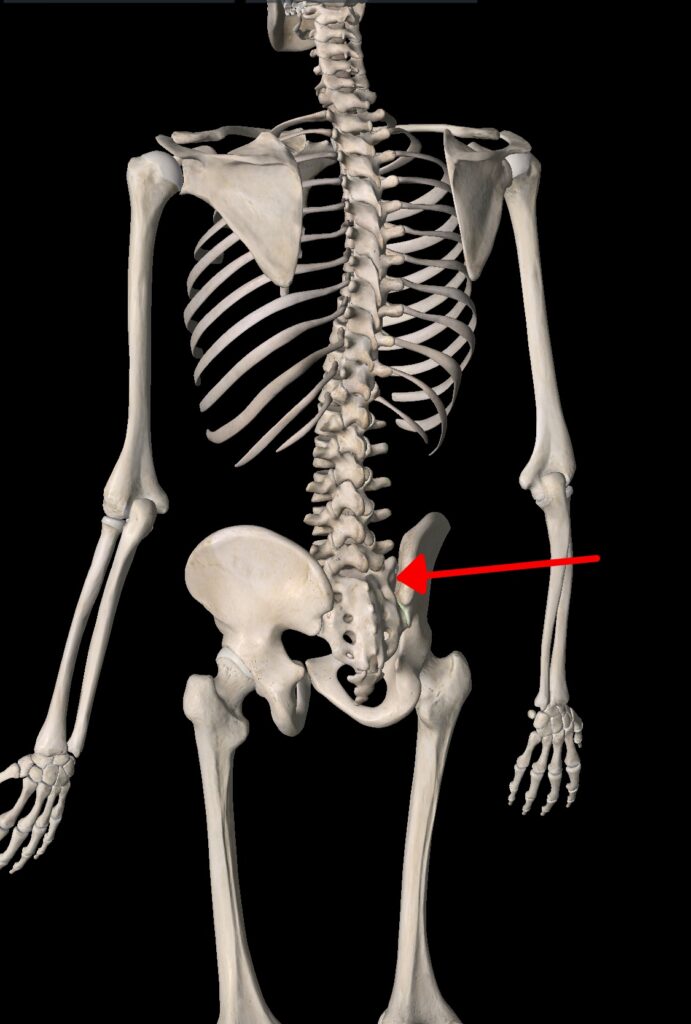
Sam also shared something no other health care provider I’ve seen over the past three years—doctors, PAs, pain specialists, or PTs—has said: post-menopausal women are prone to SI joint dysfunction, the joint becoming looser with excess “give” after losing estrogen. (I went through menopause over 20 years ago, in my mid-forties.) And, SI joint dysfunction can recur, which fits with what I’ve been experiencing: pain and function that ebbs and flow, depending on what I’ve done to irritate it (e.g., falling while running or xc skiing, or lifting something too heavy). That also explains why MRIs, taken at various times, usually months apart, kept showing edema in that area. Trauma causes edema, but I thought there could only be a single SI joint injury. Instead, it can be loosey-goosey in old broads like me, and each injury could cause edema that shows on an MRI. And a loose, dysfunctional SI joint can cause nerve pain. Because it’s a thing, there are now health care professionals who specialize in treating the SI joint of post-menopausal women. Who knew?
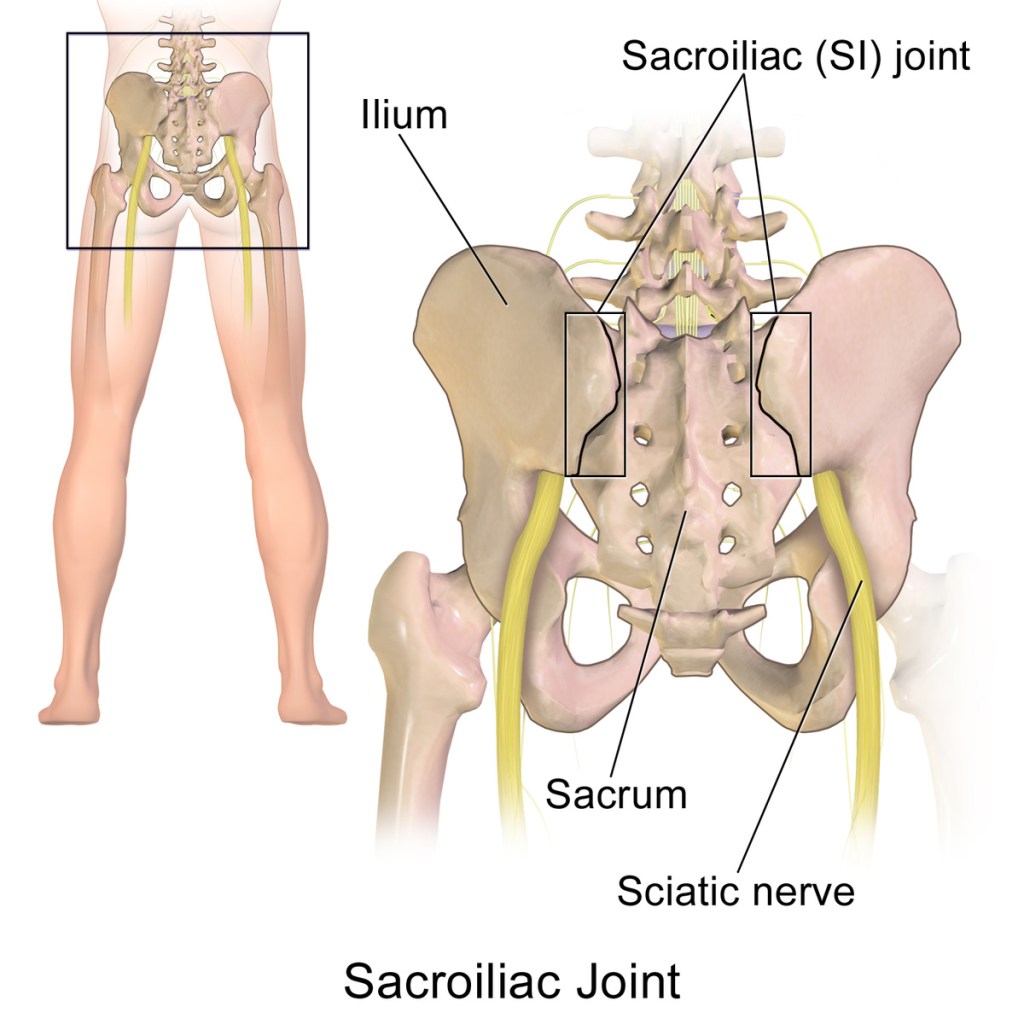
Credit: Wikipedia Commons.
Such a critical piece of my pain-journey puzzle. Sam’s information is priceless.
I told Sam this long ride on the pain train is like slowly reading a mystery novel as I go. I’m ready to get to the end where the facts add up to a conclusion that solves the underlying mystery.
Sam told me she enjoys a medical mystery.
Turns out Sam recently took what is, for her, the coolest job: sports PT to Indy car racing teams. She just moved to Indiana. Summer is racing season. She travels with the teams all over Canada and the US. She’s really busy right now, but she’s willing to help me on her days off. She’s already helped me immeasurably.
So. Putting my father’s long-ago lesson to work, I befriended my car mechanic, a friendship that lasted many years. Because of that bond, he asked if I could help his daughter. That led to befriending Sam. And now? I’m confident Sam’s going to help me figure out what the hell’s going on with this nerve pain and fix it, hopefully through strength training and exercises, but if necessary, with drugs, or (we both hope it doesn’t come to this) surgery.
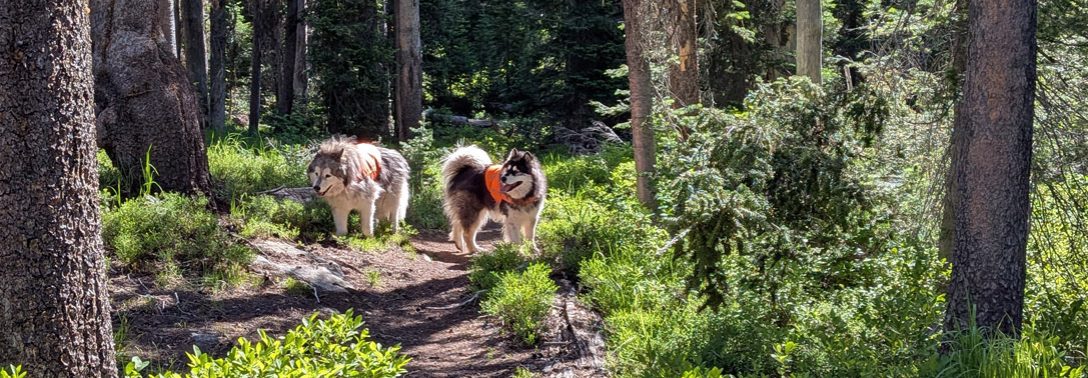
Sam’s articulate and whip smart. I can’t believe my luck. With Sam on my team, I believe I can eventually enjoy pain-free slow trail slogs through the forest with my dogs.
Dad was right. Treat everyone the same, with respect and kindness. Especially your mechanic😊
Featured image: X-ray of a sacroiliac joint, showing left side (right hand in image) with a slightly larger gap that the other side, a cause of SI joint dysfunction. Credit: Johns Hopkins CT division.


Really lovely story, Becky! Thank you!
LikeLike
Thank you Martha; glad you enjoyed the post. Such a fun experience for me!
LikeLiked by 1 person
That came through your writing!
LikeLiked by 1 person
Interesting story with a long thread. I remember at one time being enchanted with a long thread running through The Lord of the Rings. Bilbo does not kill Gollum when he has a chance early on in The Hobbit. A consequence comes at the end of the long quest when Gollum is the cause of the destruction of the ring. The results of kindness spread
LikeLiked by 2 people
Sometimes it takes time for kindness to work its magic 🙂
LikeLiked by 1 person