The Vermont town I currently call home was established in 1781. Cabot is a charming place to live, full of history.
Being new here, in 2023 I created a series of presentations by local authors, readings given at the town library. I had a selfish purpose: I wanted to meet and connect with other writers in the area.
Jane Brown kicked off our series. She gave a presentation about how she and other members of the Danville Historical Society put together and published a history of the Cabot and West Danville areas. Titled West Danville, Vermont, Then and Now, 1791 – 2021, it’s a wonderful collection of photos, maps, and personal histories of the people and businesses who have called this area home.
Listening to Jane speak, I was delighted to learn that she had personal knowledge of much of that history. Ninety-one years old, she was engaging, warm, funny, and added personal anecdotes to some of the stories included in the book.
Later in the author series, I gave a presentation about my own book. Jane attended and purchased a copy.
A wonderful friendship has developed, primarily through email (we’re both introverted writers). I learned that Jane was born and raised on the farm just up the road from me. As children, she and her cousins played in the woods and fields through all the seasons, and went to school together in the one-room schoolhouse just down the road.
For the July 4th holiday, Jane shared the following poem she wrote in Cabot’s monthly newspaper. Her historical context is in italics.
I asked Jane if I could publish it here, and she graciously obliged. Jane also did the illustrations.
The Center of Town is one of Cabot’s earliest historic spots, and a very serene one. This is where the first town meetings and church gatherings took place, where the village pound, stocks, and first tavern stood. It is the site of Cabot’s first burying ground, established in 1799. The buildings are gone, but the cemetery, with its rows of weathered fieldstone markers bearing names of the earliest settlers such as Adams, Heath, Hitchcock, Morse, Osgood, and Smith, is a grim reminder of the men and women who struggled in the wilderness to create this little community.
The Center hosted the town’s business affairs for about 40 years until it was displaced by the need for waterpower. Business moved to the valley where there were mills on the Winooski River. The Center was abandoned – the last burial at the little cemetery was in 1849.
Still, people gathered at the Center in the late 1800s for Fourth of July picnics, and later Old Home Week celebrations. In 1901, a large boulder was placed at the crest of the hill where the first meeting house and school once stood. Gradually, the cleared land became a fine grove of trees and in time, the stone walls that defined the old pound and the roadway were overgrown with ferns, moss and wildflowers. Today it is a quiet, solitary spot where it’s easy to imagine the plodding oxen used to till the soil and children happily playing in the school yard under tall evergreen and maple trees. If you visit, listen carefully, for it was here, beside the stump of a tree, that David Morse once took a solemn vow. This is his story:

SQUIRE MORSE’S HONORABLE SON
By Jane Brown
In a certain book about Vermont early history
Is the following story, ‘tho how it could be is a mystery.
It says that Jame Morse, a gentleman fine
Came from Massachusetts in 1789.
He walked north with his family, up hill and down
To Cabot Vermont, at the Center of Town.
He cleared land for a cabin of logs, mud and rock,
And settled his wife, his children and stock.
The townsfolk respected James Mores, Esquire.
They said he had knowledge the town did require.
They made him their moderator, then said, “Wait just a minute!
Our town is growing—we need a Justice of Peace in it!”
So they made James a Justice, but he did declare,
“I know nothing of weddings, so I’d best prepare.”
He called upon David, his eldest son,
And said, “Stand by that tree stump and I’ll practice what’s done.”
Young David stood by the chopped off tree
Squire Morse boomed with importance:
“REPEAT AFTER ME!
I DAVID, TAKE THIS TREE AS MY LAWFUL WIFE
TO LOVE AND PROTECT FOR THE REST OF MY LIFE.”
Dave repeated those words, sincere and true.
“You’re now man and wife,” Squire said. “We’re through!”

The years went by and many were married,
But David remembered the vow that he carried
He was faithful to the stump, ‘tho many a lass
Let him know she’d be willing, if only he’d ask.
“I’m sorry,” he’d say, “I cannot marry thee
For I’m already married to that yonder tree.”
With weather and wear through the years it diminished,
But ‘twas twenty-two years before that stump was finished.
When Old Dave saw it all crumbled and rotten,
He knew his vows could at last be forgotten.
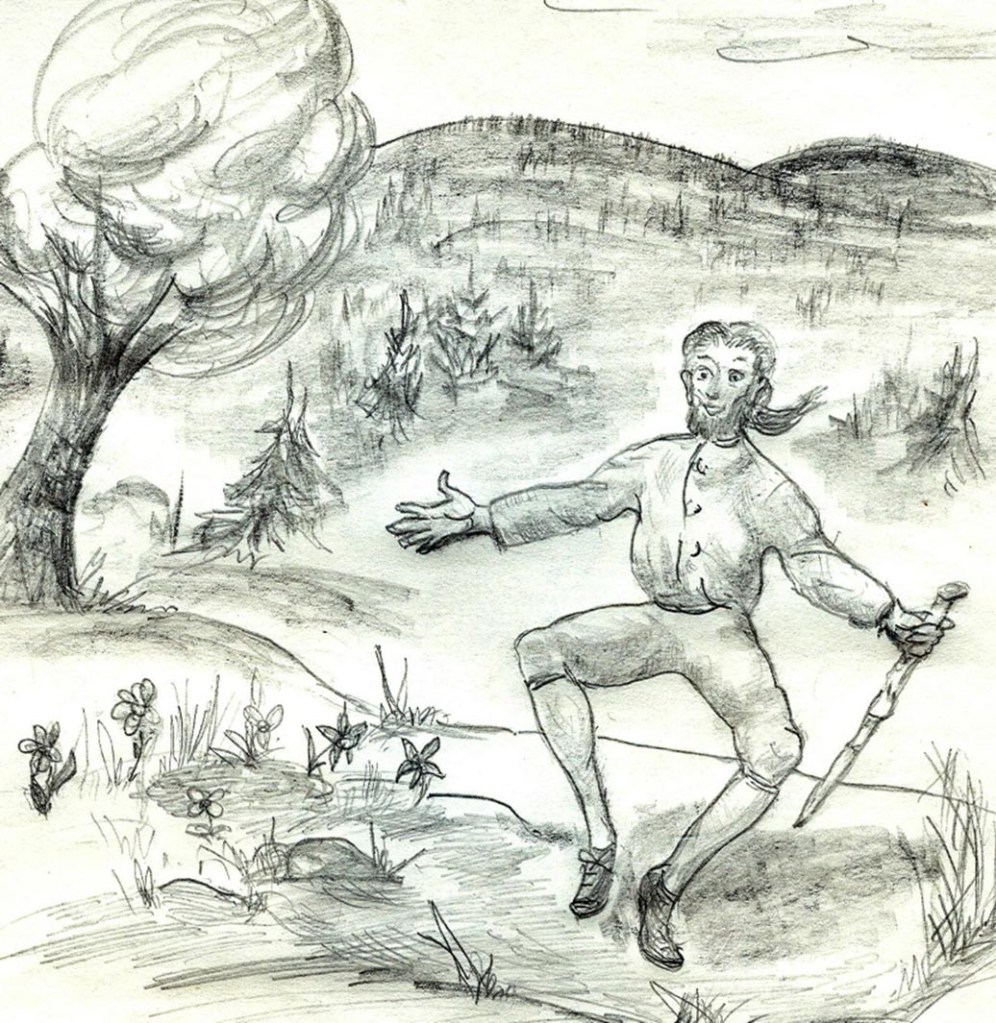
He hurried to town to find the young girls
Who had teased him so with their smiles and their curls.
But the pretty young things were now all old ladies
With husbands and children and even grandbabies.
Alas, thought poor David, for me it’s too late.
Being wed to that tree was a terrible fate!
He left the village feeling sad, lonely and old,
Heading home through the forest all dreary and cold.
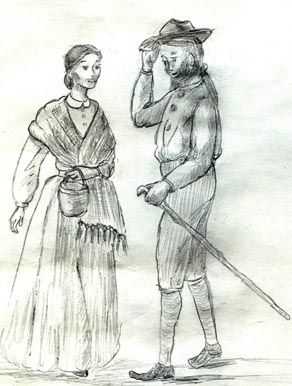
On the path came a woman, her hair pulled back tight.
Her smile was like summer, her eyes deep as night.
Dave stepped to one side and tipped his cap slightly.
She stopped and reached out to touch his cheek lightly.
She spoke with a voice like an angel’s in Heaven –
“I remember you, David – when I was but seven
I watched as your father married you to a tree
And wished in my heart that it could be me.”
“Who are you?” Dave asked, holding fast to his cane.
She curtsied and smiled.
“Meribah Woodbury’s my name.”
“Your husband?” asked David.
“I have none,” she said.
“Will you have me then?”
She nodded her head.
Dave’s friends all rejoiced as soon as they heard.
But others complained the whole thing was absurd—
Dave was crazy to be faithful to that stump on the hill,
And any woman who’d marry him must be crazier still.
On the tenth day of April in 1810,
David stood before the Squire again.
The words rang out clearly—he knew them by heart.
“I’ll love and cherish you ‘til death do us part.”
His bride was a vision—so demure and sweet.
Dave was bursting with love from his head to his feet.
The next spring Dave and Meribah had their first son.
Dave proudly named him George Washington.
When the next baby came, they named him Jare;
Then Sally was born – but they didn’t stop there.
There was Jesse, Joshua, Franklin and Nilson—
Six boys and a girl—the house was quite filled then.
The youngsters were happy and grew up just fine.
Some stayed in Cabot, some left in due time.
They are all gone now, every last one,
Resting peaceful and quiet, their work on earth done.
But at the Center of Town there’s said to still be
A restless stirring where there once was a tree.
If you stay very quiet and patiently wait,
Folks say that you’ll hear the stump calling her mate.

Historic records verify that James Morse came to live in Cabot in 1789. He built the first log cabin at the Center of town, and later ran a tavern there. He was moderator at Cabot’s first town meeting, a legislator, and Cabot’s first Justice of the Peace. The first marriage in Cabot, performed by Justice Morse, was David Lyford to Judith Heath in 1795. David Morse was about 29 when he was married to the stump. Squire Morse died in 1812 at age 66 and is buried in the Center of Town Cemetery. I found no record of his wife, Hannah, but she was probably also buried there.
Records show David Morse married Meribah Woodbury in 1810 when he was 46 and she was about 24. David died in 1834 at age 68 and Meribah died nine years later at age 58. Both are buried in the Cabot Village Cemetery.
***
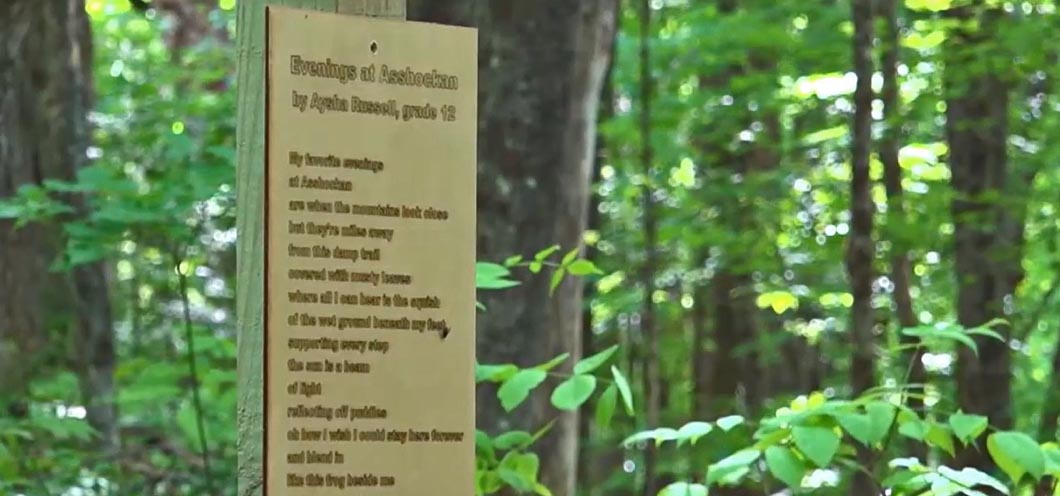
On May 29th this year, the Cabot Trails Committee officially opened the town’s newest public path, the Old Town Center Trail. Covering roughly a mile, it starts behind the 100-year-old Willey Building, housing the Town Clerk, Treasurer, and Library, and heads about a mile uphill through trees to just beyond the Old Town Center Cemetery. Local students wrote poems, then built and helped install sign posts to display the poetry alongside the trail. I have yet to visit the new trail myself, but a Vermont TV station did a story on it, with video showing the kids involved, the old cemetery, and the overall small town vibe: https://www.wcax.com/2024/06/12/cabot-high-schoolers-pioneer-new-poetry-trail/
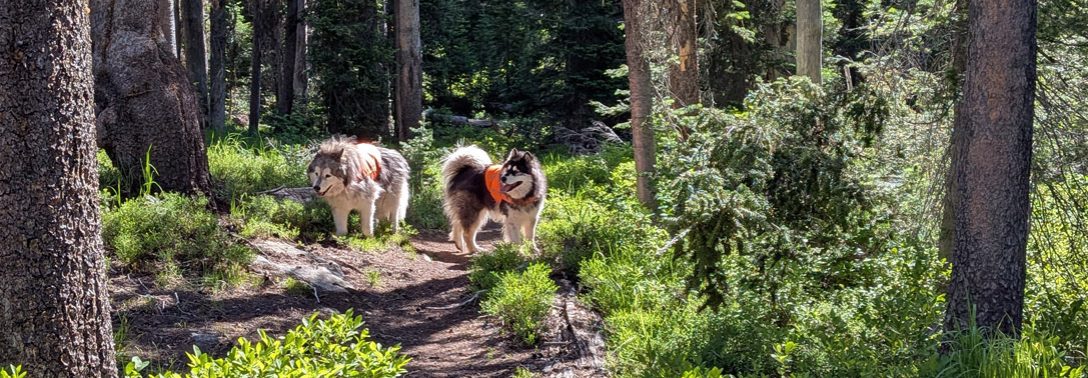
Feature photo: screenshot taken from the WCAX video. All illustrations by Jane Brown, used with permission.

 Wild Sensibility
I love this! Thank you! It’s just wonderful.
LikeLike
What a cute poem. I’ve found a good writers’ community at my library as well.
LikeLike
Loved the illustrations and how Jane incorporated so much history into her poem.
LikeLike
[…] Bringing History to Life through Poetry […]
LikeLike