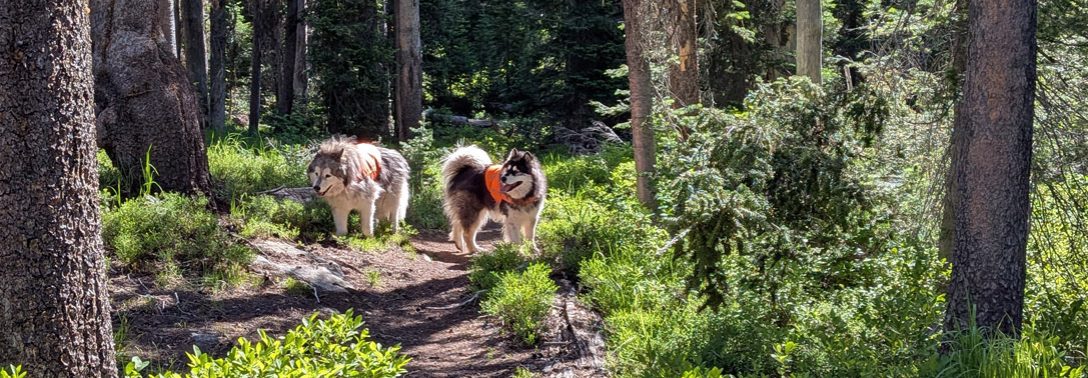
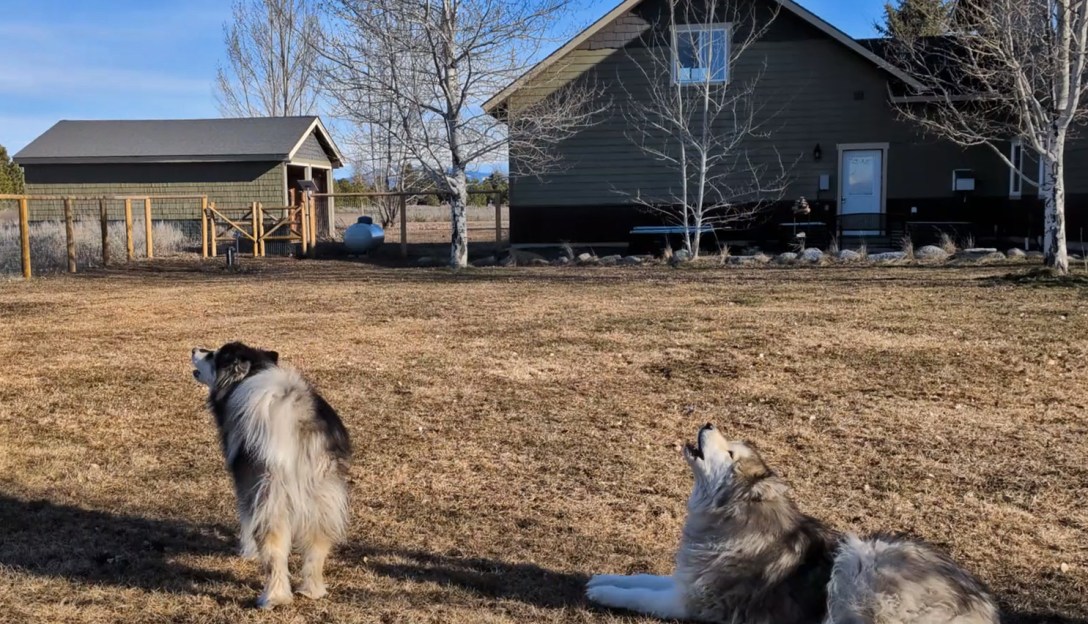
Coyote mating season typically runs from January through March, peaking in February. Coyotes become more active and territorial, and in my experience, far more vocal with their barks, yips, and howls.
My Alaskan Malamutes pay attention. Listening intently.
Then respond with their own loud howls!
When I lived in the Seattle area, my two female Mals would “sing” along with sirens, whether police or fire. It was always fun when we were out walking in the neighborhood and we heard a siren approaching. Maia and Meadow, tethered together by a coupler on the leash, would both sit on the sidewalk and listen. When the siren got close, they’d stretch their necks and jut their chins skyward, emitting long, piercing howls. As one girl’s howl wound down, the other would start hers, alternating that way until the siren passed and its sound diminished.
Because cars pulled over to let the emergency vehicle pass, random people would hear the girls singing. I loved watching their reactions: pointing, smiling, and laughing. Sometimes they’d roll down their windows to get a better listen, then tell me how cool it was to hear.
It was like witnessing a bit of the wild in the suburbs.
Malamutes inherited their wolf ancestors’ propensity for vocalizing with howls. They also bark, but rarely. Howling is just one of many things I love about them. Plus, they don’t overdo it, like some huskies. It’s usually obvious to me what prompts them to howl, and it’s always just for a minute or two.
To me, it’s music.
Coyotes vocalizing nearby is another sound that always gets my Mals howling.
What I don’t fully understand is what my dogs’ howls convey to the coyotes. Stay away? I think it is most likely territorial. A warning.
For the coyotes, though, vocalizations are far more specialized and fascinating.
Tricksters
Coyotes are extremely social and vocal, and for that reason are often referred to as “song dogs.” Their unique voices mean family members can identify individuals from a distance.
They use howls and group yip-howls to gather their family, to socialize, or mark territory. Barks and huffs usually signify alarm or a threat.
Once, walking through the woods near our Vermont home in early summer, Conall stopped, dropped his tail (a signal that he’s concerned) and stared through the trees. A moment later, I heard barking, sharp and insistent. It took me a second to realize it wasn’t a neighbor’s dog. I immediately leashed Finn, whose loss of hearing meant he was oblivious, but he could still see well; I didn’t want him to notice movement and chase. Once Finn was secure, I followed Conall’s gaze and saw the coyote. She was probably moving her pups from one den to another when we surprised her and warned us to stay away with her barks. We did.
If there are multiple coyotes, the variety of sounds produced by each coyote and the dissonances between them can make it seem as though there are many more coyotes than there really are.
That’s called the “Beau Geste Effect.” It’s an auditory illusion where a few coyotes (often just two) create the sound of a large pack—perhaps seven or eight—by producing a high volume of varied, high-pitched vocalizations and taking advantage of environmental echo, with the sounds bouncing off terrain, trees, even buildings. Often a mated pair alternates these vocalizations, and it can sound chaotic and distorted, as if they’re more spread out than they are. This technique serves as a territorial defense mechanism, an auditory fence warning off rivals, making a small family unit appear as a large, intimidating group.
These auditory illusions are one reason coyotes are often described as “tricksters” in North American Indigenous creation stories.
A zoologist coined the phenomenon’s name in 1977, after the 1924 novel Beau Geste, in which soldiers propped up deceased comrades to appear more numerous in battle. Some birds and frogs also use this territorial defense mechanism.
After moving to Idaho in 2005, I started hearing coyotes vocalizing regularly. Maia and Meadow sometimes responded with their own howls, but not every time. A few times when we were running or hiking in the forest, the girls would pause and stare into the trees. Following their gaze, I would see a lone coyote, something they heard following us from a distance. The girls didn’t enjoy being followed but didn’t feel threatened. When I researched the coyote’s behavior, I learned that coyotes protecting their young will “escort” dogs and people away from their den sites.
Later, Conall upped the singing ante, frequently responding to coyotes nearby. Finn, my Aussie, never responded to them, even when the coyote was visible in the field.
After moving to Vermont in July of 2021, Conall’s response to coyotes continued. We lived in a rural area, so we often heard them, but I never saw a coyote there. Eastern coyotes are both larger and much shyer than their western counterparts.
When I added Chann to our pack in 2023, I paid close attention to his response to coyote vocalizations. Would he howl in response, like Conall? Would he learn that from Conall?
Chann arrived in July of 2023. The first time he heard coyotes yipping nearby in August, at three months old, he was clearly frightened despite sitting right next to me on the front steps. He seemed more afraid of Conall’s response, which that evening was quiet barks and growls. Perhaps Conall was teaching Chann to be wary of coyotes and their singing.
Three months later, at six months of age, Chann was still wary of the coyotes but less intimidated by Conall’s response to them, which again was more barking and growling than howling.
A year later, Chann—out in the yard by himself—responded with full-throated howls of his own, each beginning with a slight growl/grumble. He found his singing voice and seemed to know exactly the territorial message he wanted to send.
Did he learn that from Conall? Or is this sort of response simply hard-wired in the brains of Malamutes?
I think it’s the latter. After all, when I got Conall as a puppy, both Maia and Meadow were gone. He had only Finn to mirror, and Finn never responded vocally to coyotes.
Conall and Chann didn’t miss a beat after we moved back to Idaho in late 2024, both responding to the coyotes vocalizing in the valley pastures surrounding us as soon as we settled in. Sometimes I wish they would give all the singing a rest, though, because often the coyotes sing at 4 am and I have to get out of bed to bring the boys inside before they wake the neighbors.
Expanding Their Repertoire
Lest you think it’s only sirens coyotes that elicit a howling response from my Mals, here are two other examples.
First, the bugling of elk during rutting season got Conall howling one night at sunset at our first Idaho house.
This is one of my all-time favorite videos of Conall. I love how he looks over his shoulder at me to make sure I’m taking it all in, and the sunset colors in the sky made a beautiful backdrop. (You may have to turn the volume up to hear the elk bugling; they were about a mile away at the bottom of the slope, in a neighbor’s pasture.) Conall’s relaxed the whole time, just listening and responding, no threat perceived, no need to protect territory.
Second, the drone of airplane engines. And not just any airplane. The boys ignore commercial jets flying overhead, and they also ignore most single-engine civil airplanes flying at lower altitudes. But twin-propeller airplanes flying low get Conall singing. Around here, those are typically Forest Service smokejumper airplanes training for the upcoming fire season. In this video, I was watching one making big circles over the valley. When it flew directly overhead, Conall started singing. Chann initially seemed confused, like, “Conall, what are you singing about? I don’t hear any coyotes….” But quickly Chann joined in, learning from Conall that these airplanes are worthy of a howling song.
Chann’s initially confused but decides to join in. March 2026.
Selfishly, I like to think the boys’ reaction to such airplanes is a cosmic connection with my father. He was a Boeing test pilot. Throughout my life, I flew in private single-engine airplanes with him. Dad passed away in 2009. He loved dogs and taught me how to love and care for them. The sound of propeller airplanes flying overhead always makes me think fondly of him. Hearing the boys sing? Even better, as if my father were communicating with me through them.
PS: If you have a dog that responded in some way while you played any of these videos, maybe a head tilt as they listened, a quick search for the source of the sound (like Conall and Chann, who run out through the dog door to check), or even a howl of their own, I’d love to know. Drop me a line in the comments!

 Wild Sensibility
A little more than a line… https://marthakennedy.blog/2026/04/01/whos-a-trickster/
LikeLiked by 1 person
Whoa; clearly we were both thinking about coyotes at the same time! Those little tricksters…;-)
LikeLiked by 1 person
I love ’em!
LikeLike
I’m not sure what’s more amazing… your singing canines or those stunning Idaho views.
❤️
LikeLiked by 1 person
I’m so fortunate to have landed where I am! I marvel at the mountains, sunrises and sunsets, forest trails nearby… never gets old!
LikeLiked by 1 person
I though you were still in Vermont. Shows how far behind I am. Love dem singin’ Mals.
LikeLiked by 1 person
I didn’t stay there long, just 3.5 years. Didn’t like it and was grateful when my circs changed and I was able to return to Idaho’s mountains.
LikeLike